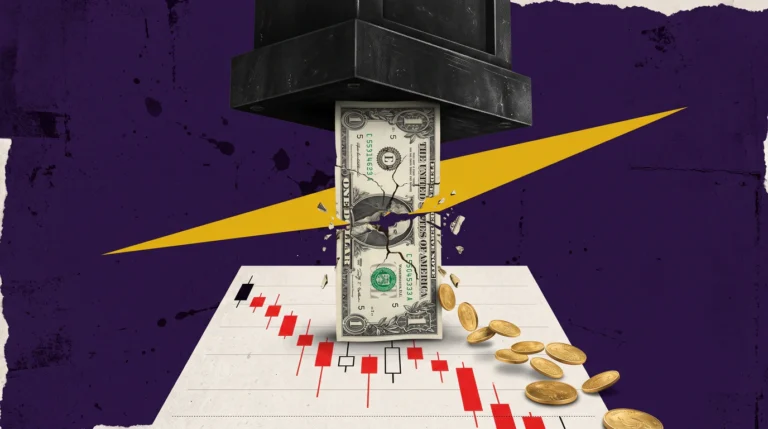

Traditional market logic dictates that cooling inflation and dovish Federal Reserve expectations should crush the US Dollar. Yet, the Dollar Index (DXY) is climbing toward 100.80. This is the ‘USD Smile’ in action: a macroeconomic phenomenon where the greenback strengthens not on domestic economic dominance, but on global risk aversion. With US Central Command enforcing a formal blockade in the Strait of Hormuz and Gold violently sweeping down to an intraday low of $3,958 before reclaiming $4,059, the market is aggressively pricing in a geopolitical premium. To navigate this dichotomy, traders must abandon linear retail narratives and map the institutional order blocks driving this cross-asset volatility.
The Brutal Truth
The Data: US Initial Jobless Claims dropped to 208K, decisively beating the 217K forecast, while Retail Sales slowed to 0.2% MoM.
The Shift: Fed rate hike expectations have been pushed back to December 2026, yet safe-haven demand is overriding dovish pricing, creating a complex trading environment.
The Execution: Trade the liquidity sweeps, not the headlines. Gold’s dip to $3,958 was an institutional accumulation zone, not a macroeconomic trend reversal.
The Tape: Cross-Asset Divergence
To navigate the current financial landscape, one must analyse the mechanics of algorithmic price delivery against the backdrop of escalating geopolitical realities.
According to verified market data, the US labour market remains resilient despite a cooling inflation print (-0.1% m/m). However, the dominant market driver today is geopolitical friction. The US military launched a new wave of airstrikes targeting Iranian command centres and missile sites, prompting US Central Command to announce a formal blockade of Iranian ports, with 20 warships now operating in the region.
This environment has created distinct, sometimes counter-intuitive, asset class behaviours:
- Gold (XAU/USD): Currently trading at $4,059.00 (+0.37%). The intraday flush to $3,958 was a classic sell-side liquidity sweep, where algorithms triggered retail stop-losses below the $4,000 psychological level before institutions aggressively accumulated the discount.
- WTI Oil: Hovering near $79.00 per barrel (-1.6%). Despite the Middle East supply risks, traders are taking profits following recent advances, showcasing the market’s struggle to price in the blockade premium.
- USD/JPY: Stabilising near 162.15. The softening US yield advantage is being offset by broad safe-haven USD demand, keeping the pair dangerously close to historical Bank of Japan intervention thresholds.
- Equities & Crypto: The NAS100 (-0.77%) and Bitcoin (-1.46%) are experiencing mild risk-off rotation as capital seeks the safety of the US Dollar.
The 48-Hour Catalyst Map (GMT)
Institutional capital does not react to the past; it positions for the future. The remainder of today and the weekend contain high-impact events that will dictate the immediate narrative. All times are strictly in GMT.
- EU Consumer Price Index (Final): Today, 09:00 GMT. Forecast: Headline inflation at -0.1% MoM; Core HICP at 2.4% YoY. This will drive EUR volatility ahead of the weekend.
- US Housing Starts & Building Permits: Today, 12:30 GMT. A critical gauge of domestic economic resilience that could further support the USD Smile.
- U. Michigan Consumer Sentiment (Prelim July): Today, 14:00 GMT. Forecast: 49.5. A key gauge of how Main Street is perceiving the current inflationary and geopolitical environment.
The Institutional Playbook: Executing Through the Noise
Navigating a market torn between resilient US data and escalating global conflict requires mechanical execution. Here is your protocol to trade the immediate volatility.
Phase 1: Respect the Gold Accumulation Sweep
Retail traders saw Gold drop to $3,958 and assumed a bearish trend change, triggering panic sells. Institutions used this exact liquidity to fill massive long positions.
- Action: Do not chase the recovery. Wait for a retracement into the 15-minute or 1-hour institutional order blocks created during the impulsive move back above $4,000. Apply the 3-Confirmation Entry Trigger to enter long, with a strict stop loss below the $3,958 sweep low.
Phase 2: The USD/JPY Intervention Line
USD/JPY is lingering at 162.15, supported by a short-term bullish trend line at 161.90. However, the Ministry of Finance is actively monitoring this zone.
- Action: Shorting this pair at multi-year highs is a high-risk retail trap. Algorithms will likely engineer a buy-side liquidity sweep above 162.50 to trap early shorts before any potential intervention-driven reversal. Wait for the sweep and a confirmed Market Structure Shift (MSS) on the 5-minute chart before considering a short position.
Phase 3: EUR/USD Consolidation Boundaries
EUR/USD is trapped in a tight range between 1.1400 and 1.1500, currently at 1.1433.
Action: Avoid trading the middle of the range. Let the 09:00 GMT EU CPI data trigger a liquidity grab at either the 1.1400 support or 1.1500 resistance. Fade the false breakout by waiting for the price to close back inside the range, targeting the opposite side of the consolidation.ht in The Legacy Method to place your limit order, ensuring your stop loss is protected behind the structural swing low.
The Blacklist
Survival in professional trading is dictated by strict adherence to rules, especially when geopolitical narratives are shifting violently.
NO-GO 1: Do not open new positions 2 minutes before or after the 14:00 GMT U. Michigan Consumer Sentiment release if you are trading a funded evaluation account with FundedNext or Fundingpips. Most prop firms strictly prohibit trading during high-impact news windows. Violating this will result in an immediate breach of your account.
NO-GO 2: Do not attempt to ‘guess’ the direction of WTI Oil based on headline news. The 1.6% drop today proves that headline geopolitics do not always equal immediate price action. Trading oil without a confirmed technical order block is pure gambling.
FAQ
What is the ‘USD Smile’ effect?
The USD Smile is a macroeconomic theory where the US Dollar strengthens during two extremes: when the US economy is exceptionally strong (high rates), and when global risk aversion is exceptionally high (geopolitical crises), regardless of domestic data.
Why did Gold drop to $3,958 if inflation is cooling?
Cooling inflation initially strengthened the Dollar, which pressured Gold. Algorithms used this momentum to engineer a sell-side liquidity sweep down to $3,958, triggering retail stop-losses before institutions stepped in to buy the physical metal at a discount.
How does the Strait of Hormuz blockade impact Forex?
It introduces a ‘geopolitical premium’ into the market. This typically drives safe-haven flows into the US Dollar and Swiss Franc, while pressuring high-beta, risk-sensitive currencies and energy importers.
What are the prop firm rules for today’s US data releases?
Firms like FundedNext and Fundingpips enforce strict news trading restrictions. Opening or closing trades within a specific window (often 2 minutes) around high-impact releases like the Michigan Sentiment is a direct violation of consistency rules and will result in account termination.
Stop guessing where the market will go during macroeconomic repricing. The Legacy Sprint™ is a 40-day virtual cohort designed to install The Legacy Method™ into your daily routine. You will master the 3-Confirmation Entry Trigger, and implement The Tri-Document System to trade with institutional rigour.
Want to start mapping structure immediately?
Download the SMC Guide Sheets to get the exact visual frameworks for identifying institutional order blocks and liquidity sweeps on your charts today.
⚠️ Trading involves significant risk of loss. Past performance is not indicative of future results. This content is for educational purposes only and does not constitute financial advice.