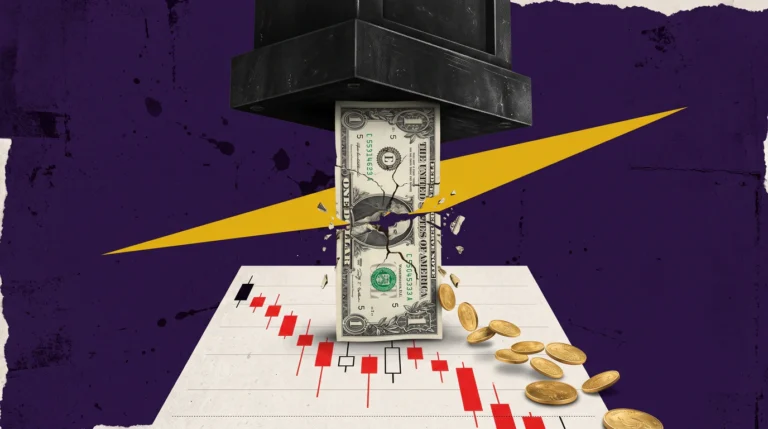

The US dollar crashed following a disastrous 57K Non-Farm Payrolls print, missing the 115K consensus. This severe labor market cooling has slashed Federal Reserve rate hike probabilities below 20%, forcing a rapid repricing of global currency markets.
You watched the dollar get hammered yesterday after the Bureau of Labor Statistics released a catastrophic jobs report, and now you are wondering if your long-USD positions are dead or just paused. A 57K print against a 115K expectation isn’t just a miss; it is a structural regime change. With the Independence Day holiday thinning out liquidity, this volatility is magnified, trapping unprepared traders on the wrong side of the tape. You need a clear roadmap to navigate this sudden shift in monetary policy expectations. Here’s how to trade the USD NFP shock safely and profitably.
🕓 The 24-Hour Snapshot
USD Plunges on Disastrous 57K NFP Print
- Why: Labor market cooling slashes Fed rate hike odds from 67% to under 20%.
- Level: USD/JPY crashed from 162.00+ down to 161.05.
- The Event: The U.S. economy added just 57K jobs (vs 115K expected), with the previous month revised down from 129K.
- The Reaction: Algorithmic and institutional dollar selling accelerated across all major pairs as the yield differential collapsed.
- The Next Trigger: Upcoming Federal Reserve speaker commentary and next week’s CPI data, which will confirm if this is a trend or a one-off anomaly.
The Catalyst: According to the Bureau of Labor Statistics, the U.S. added just 57K jobs, drastically missing the 115K forecast, while the unemployment rate ticked up to 4.2%.
The Reaction: Dollar selling accelerated across the board as July Federal Reserve rate hike probabilities collapsed from 67% to below 20%, fundamentally altering the interest rate outlook.
The Action: Traders must pivot to buying structural dips on EUR/USD and GBP/USD while exercising extreme caution with USD/JPY support levels during thin holiday trading sessions.
Why the USD NFP Shock Matters Right Now
As of July 3, 2026, markets are reacting to a sudden and violent deterioration in the U.S. labor market. To understand the magnitude of this USD NFP shock, we have to look at the mechanics of the yield differential—the gap in interest rates between the U.S. and its global peers.
For the past year, the dollar has been propped up by the expectation that the Federal Reserve would keep rates high to fight inflation. High interest rates attract foreign capital, strengthening the dollar. However, the central bank’s dual mandate requires them to monitor employment. When Non-Farm Payrolls (NFP) print at a dismal 57K, and the unemployment rate rises to 4.2%, the narrative instantly shifts from “inflation fighting” to “growth preservation.”
According to the CME FedWatch Tool, the market priced out rate hikes almost immediately. When the probability of tighter monetary policy drops from 67% to under 20%, the fundamental pillar supporting the dollar is removed. Institutional algorithms instantly reprice the asset, leading to the violent downside moves we saw in EUR/USD, GBP/USD, and USD/JPY.
Execution: How to Trade the USD NFP Shock
Navigating the aftermath of a major macroeconomic data miss requires discipline. Here is your step-by-step execution plan to capitalize on the repricing without getting chopped up in the noise.
1. Liquidate or Hedge Legacy Dollar Longs
If you are holding long positions on the Dollar Index (DXY) or short positions on EUR/USD based on the old “higher for longer” rate narrative, your fundamental thesis is currently broken.
- Action: Do not hold and hope. Close out legacy dollar longs immediately, or hedge them by purchasing out-of-the-money EUR call options to cap your downside risk while you reassess the macroeconomic landscape.
2. Pivot to EUR/USD and GBP/USD Breakouts
The most direct beneficiaries of a weak dollar are its major counterparts. The euro and the pound are currently experiencing a massive influx of institutional buying as capital rotates out of the greenback.
- Action: Identify the new support levels established during yesterday’s crash. Wait for a pullback to these fresh institutional order blocks on the 1-hour chart, confirm a bullish rejection candle, and enter long with a stop loss safely below the NFP day low.
3. Fade the USD/JPY Bounces with Extreme Caution
USD/JPY dropped roughly 150 pips, landing at 161.05. While the macro trend for this pair has just shifted bearish, shorting it right now is dangerous due to the lingering threat of Japanese Ministry of Finance intervention.
- Action: Do not aggressively short USD/JPY on the breakdown. Instead, wait for a “dead cat bounce” back toward the 161.50 or 161.80 resistance zones. If price stalls and prints a bearish engulfing pattern at resistance, initiate a short position targeting the 160.00 psychological level.
4. Adjust Your Position Sizing for Holiday Volatility
With U.S. markets closed for the July 4th holiday, market depth is severely compromised. Low liquidity means that standard market orders will suffer from wider spreads and increased slippage.
- Action: Cut your standard position size in half until normal trading volumes resume next week. Use limit orders exclusively to dictate your exact entry price and avoid paying the spread premium charged by market makers during thin sessions.
What If It Fails: The “One-Month Anomaly” Risk
The biggest risk when trading the immediate aftermath of a USD NFP shock is falling victim to recency bias—the assumption that one bad data point equals a long-term macroeconomic trend.
What if the 57K print was an anomaly? The Bureau of Labor Statistics data is subject to massive seasonal adjustments, and one-off events like severe weather, auto-plant retooling, or strike actions can artificially depress a single month’s payroll figure. Furthermore, the previous month’s 129K was revised down, but revisions are often volatile and subject to further correction next month.
The Downside Risk: If Federal Reserve officials come out in the coming days and deliver hawkish speeches, stating that they “will not overreact to one month of noisy labor data,” the market will rapidly reprice rate hike odds back up. This will trigger a violent short-squeeze in the dollar, punishing traders who aggressively shorted the greenback after the initial NFP spike. Always wait for confirming data (like next week’s CPI) before committing heavy capital to a new macroeconomic trend.
💡 Expert Insight: The ‘Holiday Liquidity Multiplier’ Effect
Here is a pro tip that institutional desks are actively factoring into their models right now: The severity of yesterday’s dollar crash was artificially amplified by the calendar.
Because this NFP report was released a day early (July 2) to accommodate the Independence Day holiday, the market was already transitioning into a low-volume state. In a normal week, a 57K jobs miss might result in a 60-pip drop in EUR/USD. But in a pre-holiday environment where tier-1 banks have pulled their liquidity providers offline, that same selling pressure causes a 120-pip drop.
The Contrarian Take: Do not mistake a low-liquidity gap for a permanent shift in market structure. Retail traders see a massive red candle and assume the dollar is dead. Professionals see a shallow order book and recognize that the move is exaggerated. Expect a “liquidity repair” move, where price slowly drifts back to fill the gaps left by yesterday’s erratic pricing, once the U.S. bond and equity markets reopen next week.
FAQ
What caused the USD NFP shock?
The U.S. economy added only 57K jobs, missing the 115K consensus. This severe labor market cooling signaled economic weakness, prompting traders to aggressively sell the dollar.
How did the Fed rate odds change?
According to the CME FedWatch Tool, July rate hike probabilities collapsed from 67% to below 20% immediately following the report, as a weak labor market removes the need for tighter monetary policy.
Is USD/JPY going back to 162?
Not immediately. The macroeconomic trend has shifted toward dollar weakness. However, thin holiday liquidity can cause violent, temporary bounces that trap aggressive short-sellers before the broader downtrend resumes.
Should I buy gold after this NFP?
Gold typically rallies when the dollar weakens and rate hike expectations fall. However, wait for the initial post-NFP volatility to settle and confirm a technical breakout before entering new long positions.
Do not let post-NFP volatility wreck your quarterly returns. learn exactly how to audit your portfolio and reposition your trades after a major economic data shock with The Traders Legacy. ENROLL NOW
Trading involves significant risk of loss. Past performance is not indicative of future results. This content is for educational purposes only and does not constitute financial advice.