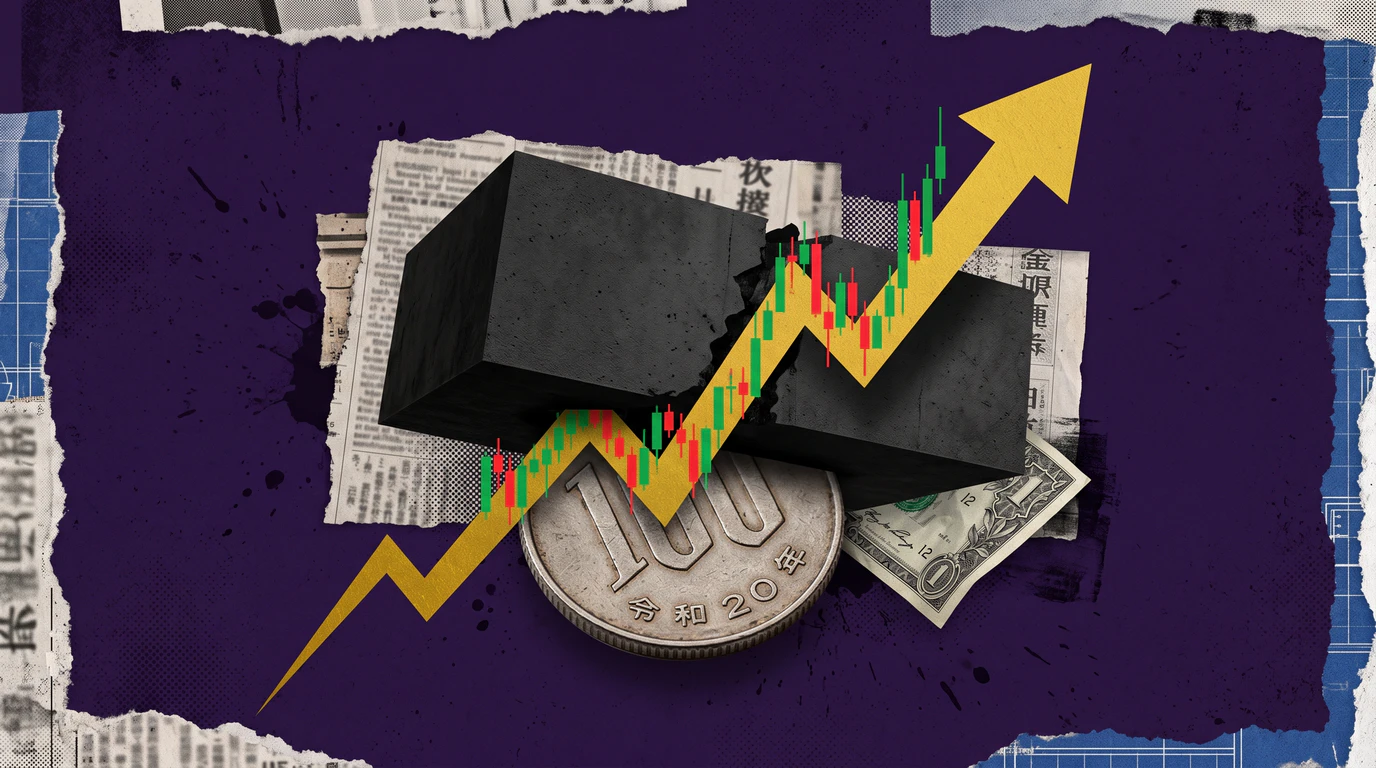
“If a central bank hikes interest rates, the currency goes up.” It is the very first rule every beginner learns in Forex. It is also the exact lie institutions use to liquidate their accounts. The Bank of Japan just hiked rates to 1.00% in June. By every traditional textbook metric, the Yen should be flying. Instead, USD/JPY is sitting at a multi-decade high of 163.15, completely ignoring the hike and pushing higher. If you bought the Yen expecting a rate-hike rally, you are not the trader. You are the exit liquidity.
The Brutal Reality
The Retail Narrative: “The Bank of Japan hiked to 1.00%. The Yen is undervalued. I am buying the dip and waiting for the currency to strengthen.”
The Institutional Reality: The 1.00% hike was a delayed, toothless move against a Federal Reserve holding at 3.75%. The headline is being used to trap retail breakout buyers before algorithms engineer a violent push to 165.00 to trigger the final liquidity sweep.
The Fix: Stop trading textbook economics. Map the 165.00 liquidity pool, wait for the algorithmic trap to spring, and execute the reversal.
The Textbook Lie and the 163.15 Reality
To understand why the Yen is ignoring a massive central bank rate hike, you have to look past the headline and analyse the actual mechanics of global capital flow. Retail traders see “1.00% rate hike” and immediately assume the Yen is now attractive. Institutions see a 2.50% yield differential and laugh.
The US Dollar Index (DXY) has pushed toward 100.80, gaining roughly 0.3% over the last 24 hours. The catalyst? US Initial Jobless Claims fell to a stronger-than-expected 208K. This single data point reinforced the Federal Reserve’s “higher-for-longer” stance at 3.50%–3.75%.
When you compare the Fed’s 3.75% ceiling to the Bank of Japan’s new 1.00% floor, the yield gap is still massive. Institutional capital does not move to a currency just because it hiked rates once; it moves to a currency that offers the highest real return. The BoJ’s 1.00% hike was entirely priced in weeks ago. When the actual announcement happened, there were no buyers left. Instead, tier-one banks used the “hawkish BoJ” news headlines to sell their long Yen positions into the retail traders who were blindly buying the breakout. This is why USD/JPY didn’t drop. It was an engineered distribution phase.
The Hidden Divergence: Why the Dollar’s Push to 100.80 is Fragile
While the Yen is weak, the US Dollar’s current strength is built on a fractured foundation. This is the secret context that makes the upcoming USD/JPY setup so highly probable.
Look closely at the US data from the last 24 hours. Yes, Jobless Claims were a strong 208K. But US Retail Sales growth completely stalled, slowing to a mere 0.2% month-over-month in June, down from 1.0% previously. This is a glaring macroeconomic divergence. The labour market is holding up, but the American consumer is out of money and stopping their spending.
Institutions know that a consumer slowdown is the ultimate killer of economic growth. The push of the DXY to 100.80 and USD/JPY to 163.15 is not a genuine, sustainable breakout. It is a liquidity hunt. Algorithms are using the strong jobless claims headline to push the Dollar into key resistance zones, trapping retail breakout buyers, so that smart money can offload their long positions at a premium before the retail sales weakness takes over.
The 165.00 Intervention Mirage: How the Trap Will Spring
Everyone in the retail space is talking about Bank of Japan intervention at 165.00. They are drawing horizontal lines on their charts and placing tight stop-losses at 164.80, expecting the BoJ to magically reverse the pair the second it touches 165.00.
This is exactly where you will get liquidated.
Institutional algorithms know exactly where retail stop-losses are clustered. If the BoJ actually wants to intervene and buy Yen, they need massive sell-side liquidity. Where is that liquidity? It is sitting just above 165.00, in the form of retail buy-stops and breakout orders.
Before the BoJ intervenes, the algorithms will engineer a massive buy-side liquidity sweep. They will push USD/JPY aggressively through 165.00, perhaps hitting 165.30 or 165.50. This will trigger all the retail stop-losses, trap the last of the momentum buyers, and generate the exact volume the Ministry of Finance needs to execute their intervention. Once the sweep is complete and the retail traders are trapped, the pair will violently reverse.
Execution Mechanics: Trading the 165.00 Sweep
Navigating this central bank anomaly requires mechanical execution. You cannot trade based on what “should” happen according to a textbook. You must trade what the algorithms are forcing to happen.
Phase 1: Map the Retail Trap Zone Open your USD/JPY chart. Identify the psychological 165.00 level and the recent swing highs. This 165.00 to 165.50 zone is your institutional kill zone. Do not short the pair at 163.15. You are too early, and you will suffer through days of chop. Wait for the price to enter the kill zone.
Phase 2: Wait for the Algorithmic Inducement When the price pushes into 165.00, watch the 5-minute and 15-minute charts. You are looking for a violent, fast move that pierces 165.00 and immediately stalls. If the 15-minute candle leaves a long wick above 165.00 and closes back below it, the buy-side liquidity sweep is confirmed. The trap has been sprung.
Phase 3: Execute the 3-Confirmation Entry Trigger Once the sweep is confirmed, drop to the 5-minute chart. Wait for a Market Structure Shift (MSS) that breaks the most recent higher-low. Identify the institutional order block or Fair Value Gap created by that impulsive downward displacement. Apply the 3-Confirmation Entry Trigger to place your limit order. Your stop loss goes safely above the absolute high of the 165.00 sweep wick. Your target is the liquidity pools back down at 162.00.potential intervention-driven reversal. Wait for the sweep and a confirmed Market Structure Shift before considering a short position.
The Next 48 Hours: The Catalyst for the Sweep
Institutional capital does not react to the past; it positions for the future. The remainder of the trading week contains high-impact events that will provide the exact volatility needed to push USD/JPY into the 165.00 trap.
UoM Consumer Sentiment (Preliminary): This is the critical catalyst. A drop in consumer sentiment will confirm that the American public is feeling the pinch of inflation. Algorithms will likely use this release to spike USD/JPY one last time into the 165.00 intervention zone before reversing the pair violently.
US Housing Starts & Building Permits: These releases will test the underlying strength of the US consumer. If they show further weakness (confirming the 0.2% retail sales drop), the Dollar will likely face immediate rejection after a brief spike.
Fatal Errors in a Central Bank Trap
Survival in the financial markets is about avoiding catastrophic mistakes. When trading a pair at multi-decade highs with active intervention risk, the margin for error is zero.
First, do not short USD/JPY at 163.15 just because you think the Yen is “undervalued.” The market can remain irrational longer than your account can remain solvent. Wait for the 165.00 liquidity sweep. Let the institutions show their hand first.
Second, do not trade the UoM Consumer Sentiment release if you are using a funded evaluation account. Prop firms have strict rules against opening or closing trades within two minutes of high-impact news. Breaking this rule will void your account instantly, even if your directional bias on the Yen was perfectly correct.
Third, never ignore the macroeconomic divergence. The US Dollar is strong on jobless claims, but weak on retail sales. This means the current USD/JPY rally is fragile. Once the 165.00 sweep happens, the reversal will be aggressive because the underlying US consumer data does not support a sustained Dollar breakout.
FAQ
Why didn’t the Yen strengthen after the Bank of Japan’s 1.00% rate hike?
The 1.00% hike was already priced in by the market weeks in advance. Furthermore, the yield differential between the US Federal Reserve (3.50%-3.75%) and the BoJ (1.00%) remains massive. Institutional capital flows toward the highest yield, meaning the Dollar’s structural advantage easily overpowered the BoJ’s rate hike.
What is a buy-side liquidity sweep in USD/JPY?
A buy-side liquidity sweep occurs when the price aggressively pushes above a key resistance level (like 165.00) to trigger retail stop-losses and breakout buy orders. Institutions use this engineered volume to fill their massive sell orders before reversing the price downward.
How do prop firms treat the UoM Consumer Sentiment release?
Funded evaluation accounts strictly prohibit opening or closing trades within a specific window (usually two minutes) around high-impact news like the UoM Consumer Sentiment. Violating this rule results in an immediate breach and termination of the funded account.
Why is the US Dollar rising if Retail Sales are slowing to 0.2%?
The Dollar is rising in the short term because the 208K Jobless Claims data was stronger than expected, reinforcing the Fed’s hawkish stance. However, the 0.2% Retail Sales drop indicates underlying economic weakness, meaning this Dollar strength is likely a temporary liquidity trap rather than a sustainable long-term trend.
Stop guessing and start executing with institutional precision. The Traders Legacy™ mentorship is built for serious traders ready to master market mechanics, eliminate retail habits, and protect their capital. Step into the arena.
Want to start mapping structure immediately?
📒 Download the SMC Guide Sheets to get the exact visual frameworks for identifying institutional order blocks and liquidity sweeps on your charts today.
⚠️ Trading involves significant risk of loss. Past performance is not indicative of future results. This content is for educational purposes only and does not constitute financial advice.